
Add Sawarri to your home screen
Sawarri then opens as a full-screen app. Your browser does the adding — here is where the option is:
Sawarri then opens as a full-screen app. Your browser does the adding — here is where the option is:
Islamabad to Abbottabad is 120 km. On the Hazara Motorway (E-35) it takes roughly two to two and a half hours. It is one of the most travelled corridors in the north of the country — students and staff heading to Ayub Medical Complex, families going home for the weekend, and a steady flow of people who work in the capital and live in Hazara.
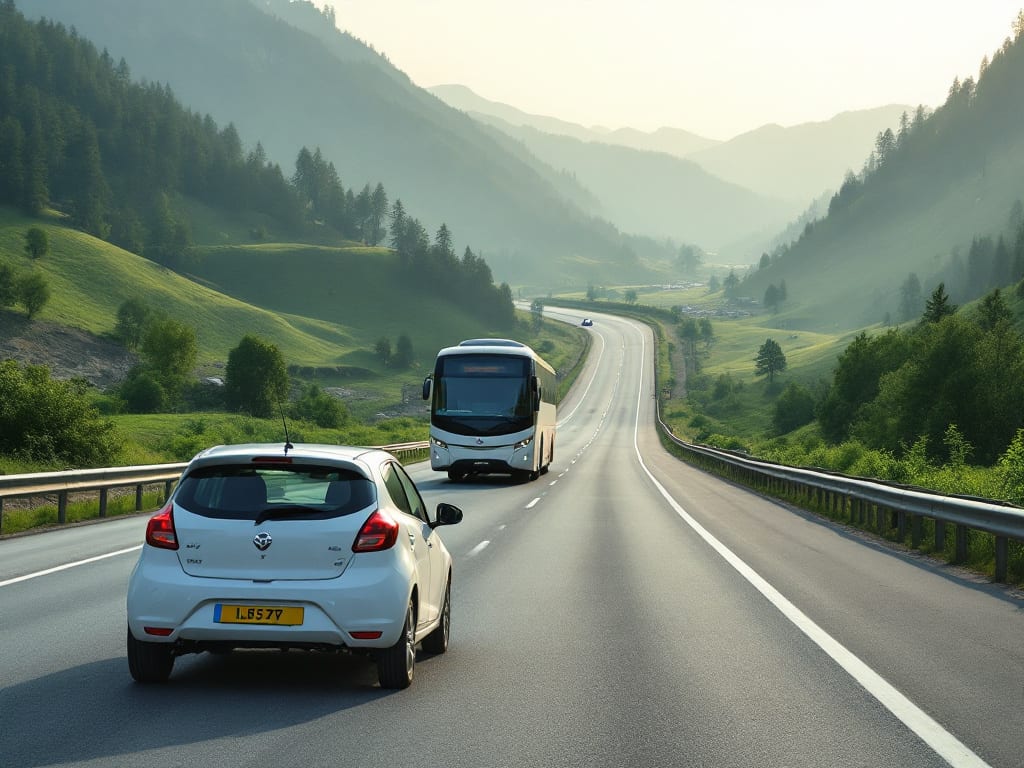
There are three realistic ways to make that trip. None of them is best at everything. Here is what each one is actually good at.
Buses run this route frequently and they are the cheapest option per person. That is a real advantage and it is why most people take them.
The cost people forget is at the ends. A bus goes terminal to terminal. If you live in G-11 and you are going to Bilal Town, the bus covers the middle of the journey and you arrange transport at both ends yourself. Add those two legs, add the waiting, and the door-to-door time and cost look different from the ticket price.
Best for: travelling alone on a budget, with luggage you do not mind handling, when your start and end points are near the terminals anyway.
Booking the whole car is the most comfortable and the most flexible option. You leave when you want, from your door, to your door.
You are also paying for the entire vehicle plus the driver’s time, for an intercity distance. Structurally this is the most expensive way to do it, and for a 120 km run that gap is not small. It also depends on availability, which on intercity routes is less reliable than inside a city.
Best for: a group splitting one car, an emergency, odd hours, or a trip where you simply cannot be on someone else’s schedule.
Carpooling sits between the two, and it works on a different principle from both. You are not hiring anything. Somebody is already driving Islamabad to Abbottabad, their car has empty seats, and you take one and share what the trip costs.
That is worth sitting with for a second, because it explains the price. A car making this drive burns the same fuel whether there is one person in it or four. The cost is being paid either way. Carpooling just splits a bill that already exists, which is why a seat costs a fraction of hiring the car — and why the maths holds up even when fuel prices move.
Practically, you also get most of the door-to-door benefit. Drivers on this corridor pick up at points they pass anyway — G-9 Markaz, Peshawar Mor, Blue Area, Faizabad — and drop at Fawara Chowk, Bilal Town, Supply, Mandian or the Complex. No terminal at either end.
The trade-off is honest: you travel on the driver’s schedule, not yours, and a seat has to exist on the day you want it. Carpooling rewards planning ahead.
Best for: the regular run — weekly commuters, students, anyone making this trip often enough that a fixed departure time is not a problem.
Fares change, so check the current price of whichever you pick rather than trusting a number you read somewhere. What does not change is the structure: a bus sells you a seat on a scheduled service, a taxi sells you a whole car, and a carpool splits a journey that was happening anyway.
Sawarri lists shared rides on this corridor in both directions. Seats are posted by ordinary drivers, the price per seat is shown before you book, and there is no commission on top.
If nothing matches your date, post the trip you need on offer or request a ride — drivers making the run can pick it up. And before you travel with anyone, read Safety.